Friday, March 20, 2009

Tuesday feature

For my zoo pics feature I decided to share pics that show species which still live here in Israel rather than anything more exotic. As I said, such pics are easy to find online and to take in captivity. Here I want to share some interesting behaviour and information.

In a historical movie I saw recently a 'portent' was reported - an eagle with a snake! This was supposed to mean something for the coming battle. I had to roll my eyes and laugh as any naturalist in the region knows what they probably *really* saw was this- Circaetus gallicus, the Short toed eagle, a raptor that specializes in snakes. I watched this majestic bird hunt over the fields of a kibbutz where I used to live years ago. This one was relieving an itch on his head!. Moshe.

The following is a sequence showing a couple of relatively young male ibex Capra nubiana, a kind of wild goat, having a sparring match in the savannah section of the zoo. We could watch the whole battle from an elevated walkway. Many Ibex live wild in Eyn Geddi, a beautiful wadi system that leads through the Judean desert into the Dead Sea some miles south of Jerusalem.


This classic beauty can say its name in Hebrew, Arabic and Latin! Or rather, the other way around, since its name was given for its call- a deep hoot 'OOO!' followed immediately by a harsh almost hissing aspiration 'hhha!' We had much success imitating him and getting him to answer back.
In English it's an Eagle Owl, Bubo bubo, Hebrew Oach and Arabic Buhah. This species still occurs in wilderness/desert in Israel, though sadly much rarer than it used to be.

Finally, Moshe wishes to share with you this sequence of the Middle Eastern Eurasian Jay heading off into the trees. Note its upward swing as it comes in to land.


And finally as promised, today's mystery pic. Cropped from another one of our zoo pics, this is a classic 'guess it' subject so I made it just a little bit more difficult- I will say no more! Anyone? To be totally fair I have to add that it's not something found in the wild today in Israel, although their fossils or those of related species have been found.

Thursday, March 19, 2009

Thurs: Tribute to successful species

One of the most wildly successful members of the pea family, the humble but wonderfully fragrant clover, this now starting to bloom by the sapling field. This is probably a variant of white or Dutch clover Trifolium repens, possibly the inspiration for the shamrock emblem. How timely!
my pic for a change.

Aleppo Pine, Pinus halepensis. I think these are the male pollen producing cones. This is the dominant tree of the Mir forest and of other forests around Jerusalem, Yaar Biriah and other parts of the country. It is found all around the Mediterranean and is also doing quite well in Southern California and Australia. Resin from this pine is used the flavour the Greek wine, Retsina and its seeds are also edible in season. (Y.T.)

An umbelliferous plant blooming quite happily for the last week or so in concentrated stands in the open along the east watercourse up to look out corner. I.D. as yet uncertain but not quite like the carrot related umbellifers, some of which are just starting to bloom near sapling field. (Akiva)

Milk thistle foliage seems to have doubled in height over the last week or so and are just now starting to bloom. These are abundant along the bank by valley road, along with wild mustard and viper's bugloss now also blooming.

Delicate pink tinted Silene is blooming by the roadside in many places. This is a campion of the Caryophyllaceae family. I took these first for S. vulgaris but now I'm thinking its S. dichotoma, the forked catchfly.

A member of a very well known genus, Ranunculus (marginatus?), otherwise known as buttercups, now blooming in many places especially in the more open northerly parts of the area. We have a joke that the area has all the elements of the fire swamp from 'Princess Bride' : Rodents of unusual size (the mole rats), 'lightning sand' (the thick mud at the north east end of gazelle field, though not so deep as to be really dangerous), the spontaneous fires and now Princess Buttercup herself! 'Of course we can survive, you're just saying that just because nobody ever has!'

Today Akiva and I walked along valley road to the pumping station, looking out for hyrax, but none active. Could be the recent rain has kept them indoors, it's been drizzling on and off all day.

We (Akiva and I) cut through the sapling field, walked along the rough trail just west of the watercourse to look out corner, scanned for gazelle but found none, then headed back to valley road along central trail.

Birds however, have been active. A sunbird was heard calling in our garden much of the day and foraging in the Bauhinia and other foliage. Several pairs of laughing doves were at crumb corner, hooded crows were about and noisy around the middle of east valley, one making repeated woodpecker drum like call. Husband glimpsed a Buteo hawk through the trees up there, no doubt the cause of all the crow noise.

Collared doves
cooing, blackbird in song in the garden and in the woods on and off all day, white spectacled bulbuls foraging and calling, graceful warblers also active, house sparrows active along the street as usual. Just after sunset as we reached the crossroads I heard a couple of distinct calls of European cuckoo from back up the trail to the ruins- headed up there a way and listened but didn't call again.


New contributor today, Aharon, my eldest, found this on windsurfer hill earlier today, snapped it with his cell phone. Can you see what this is? Click on it to see it much larger size, that should tell you :)

Temp range today: 6-15 degrees C though crickets already singing in the evening. Temp about 12 degrees when we headed out at about 5 p.m. humidity ~50%, winds WNW and light.

16th March revisited, Ophrys, caterpillars etc.

This one follows quite naturally from the last since the pics were taken in the same area just a few days before. I'd rather not delay much longer on them since the spring progresses and there are definite, though subtle changes every day.

As promised, a little collection of Ophrys orchids to show their amazing diversity in markings, all found growing in the flat eucalyptus planted east part of the north valley watercourse, before it emerges onto gazelle field. They seem to be variations of Ophrys carmeli (or closely related).
By the way, the orchid I found near the chicken machneh was identified by Amihud at the Jerusalem Bird Observatory as a variant of Ophrys apifera and considered quite rare!

These, followed by another couple of interesting plants and then more caterpillars. Enjoy!


Found near the top of the trail down to north watercourse.

Small spikes just a few cm high, consisting of tiny flowers with obvious anthers, growing in many places in the open in large mats near the watercourse. Yet to I.D.

Found on top branched deep purple flowered plant on east slopes of the hill. This I left uncollected. All the above: Akiva

Hairy caterpillar commonly found on thorny burnet and also photographed in earlier blog entries. This one the boys brought home to rear. Moshe. This one escaped but fortunately was found later on the telephone wires and secured.

caterpillar of six spot burnet, Zygaena sp. (?) Moshe

One of the Pierid (white) butterflies, found dead by the track down to the north valley. Euchloe?
Moshe

Wednesday, March 18, 2009

Flowers and insects by the North Watercourse

My favourite of the day: Amongst the foliage by the north watercourse the boys found a beautiful web with this extraordinary little orange and black spider. They took a few shots of it, then witnessed the small grasshopper landing in the web, the spider attack and wrap. They took numerous pics but this one I like best. Moshe

Lovely purple vetch growing by the path down to the north watercourse. Avremi

A low growing white lily now blooming under the young pines just west of gazelle field. Avremi

Growing by the trail on the way down to the north watercourse. Anagallis arvensis foemina Blue pimpernel. Known either a subspecies of scarlet pimpernel or considered a separate species A. foemina. Avremi

A grasshopper the boys found. I.D.d thanks to Rittner's site, Pyrgomorphella granosa, though I have no idea of its English name. Moshe.

A tiny yellow clover, pic taken by Avremi near the top of the trail leading down to north watercourse.

Today Moshe, Avremi and myself headed out to the northern watercourse early, 1 pm while husband was in a meeting. The boys wanted to get more greenery for their caterpillars and also look for other interesting insect life. Also, of course, I wanted to see what new flowers were out and what birds were active.

Birds active: Syrian woodpecker call heard, first one in days. Eurasian jays heard, great tits calls, graceful warblers active and seen (on top of acacia by valley road, Avremi was happy with a really nice view of it. Strident repeated prreeep call answered by another individual farther up the bank at least 50 yards off, also clear 'sisik' calls. Stone curlews heard from somewhere north.
Laughing dove and collared doves both heard cooing. Jackdaws heard. Blackbird song, Hooded crows and white spectacled bulbul also active.

Weather: 5.5 at night to 12 degrees C maximum, while we were out. Humidity at that time- ~62%,
wind W to NW 6-11 knots.

Tuesday, March 17, 2009

Wildlife at the zoo

Cormorants settling in for the season. Cormorants nest by the zoo lake every year and will be joined later in the spring by a colony of cattle egret if all goes well.
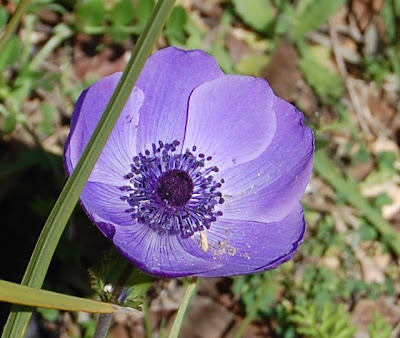
This one is for Joybaby, who loves purple flowers:) The wild red anemone has a purple variant which grows wild in the north of the country and apparently also at the zoo. I could not resist a shot!

Moshe got this one of our Eurasian jay Garrulus glandarius atricapillus snatching a piece of bread from the ground.

It flew up onto a branch in an oak tree overhead and ate in typical jay fashion, gripping the food with its feet and pecking at it.

Beautiful Adonis specimen, couldn't resist!

Honeybees busy in the rosemary. Oregano, rosemary and lavender in bloom all over the place.

For a total change we spent much of the day (11 a.m - 4 p.m) at the zoo which is situated in a beautiful valley just south of the city.
http://www.jerusalemzoo.org.il/len/ for more info

The collection itself includes species which do or have lived in Israel in decades or centuries past, such as bears, lions, leopards. The last Asian Brown/Syrian bear, (Dov in Hebrew) , was seen visiting Yam Kineret, (The Sea of Galilee) by the zoologist Tristram in the beginning of the 20th century. Today I watched a Syrian bear splashing his paw in his pool, trying to catch the carp!

Persian leopards
namer persisted in the northern forests of the country such as Banias and Yaar Biriah up to maybe 50 or 60 years ago and a desert subspecies still just hangs on in the Judean desert near Eyn Geddi to this day. Today we came very close to one as it seemed it was just as curious about its visitors as we were about it, and came right up to us. I'm using a pic of this gorgeous great cat as my desktop background at the moment, want to see?

Lions no longer live here sadly though they are still the symbol of Yehuda (Judaea) . The Asian lion Aryeh in the collection appeared to be flat out fast asleep, which frankly I envied since I was wiped. The cheetah, however was quite active. Wild Cheetahs are thought to have finally disappeared in Israel back in the 1950s, sadly though work is in progress to bring it back and restore its place in the ecosystem of the desert south of the country.

The zoo also has herds of ibex and gazelle as well as other antelopes in the safari section and we watched two buck ibex sparring from an overhead walkway. There were also many other species not ever native to the country such as Sumatran tiger, cotton top tamarin, siamangs, Thai elephants and many many other species. The tiger seemed to be gazing at me with a look of profound reproach though a young male mandrill was much more friendly and tried to kiss the boys through the partition! The elephants honestly looked rather woebegone but I'm probably projecting again. There were many other species we saw, would take too long to describe everything but probably the highlight for Moshe was a close encounter with a great hairy armadillo which did not object to being cuddled, yes you heard me right. Moshe cuddled an armadillo and tickled its belly. He got ahead of us, got into its enclosure in the tropical birds house when the staff were off, I don't know what, having coffee but noone in sight to tell him nay. Very naughty of him yes, but who can blame him for making the most of it!

It's easy to take great pics of captive lions, tigers and bears so I have not included those here today, though we did take them, and of other species! If you want to see any of our pics of the collection I will happily upload them for you, but as you know I generally focus on the wild stuff.

As for wild birds, there were plenty! The zoo is a great place for them as it provides plenty habitat and food. Of course house sparrows and feral pigeons were flourishing all over the zoo, blackbirds and laughing doves were also abundant. Around the lake the collection of flamingos, pelicans, swans etc were augmented by wild mallard duck Anas platyrhynchos, numerous Cormorant Phalocrocorax carbo, some fishing, some drying out their wings, flying in, flying out, sitting on nests and generally settling in for the season. Moorhens Gallinula chloropus, were abundant on the shores of the lake and there were quite a few spur winged plovers Vanellus spinosus about, calling 'sik sik!' and wheeling around above. No sign of any cattle egrets yet. A flock usually nests here but apparently not arrived.

White breasted kingfishers
Halcyon smyrnensis were obvious all around the lake, calling and looking flashy. They had a new call I had not heard before, a repetitive loud simple trill, falling in pitch. I suspect this is a mate attraction call since I have not heard this at any other season. They also made their more familiar calls from time to time but the trill was insistent all day.

Some chukar partridges were seen in an area of oak, carob and other foliage and cover and Eurasian jays were everywhere. While resting I used part of my cheese sandwich to lure it down so that Moshe could take pics. (Above) It was using a branch directly above me in an oak tree and approached within a few feet, evidently used to grabbing scraps from picnickers.

Sunbirds were heard and seen about, calling and singing, a snatch of blackcap song was heard, a nice male greenfinch was noticed and photographed in a bare tree, (I haven't finished processing all the pics we got yet) some tantalizing calls that sounded like they could be masked shrike were heard in various shrubberies but those birds did not show. White wagtails Motacilla alba still around, several seen on zoo lawns foraging for insects, and white spectacled bulbuls heard and spotted all over.

Hooded crows were also noticed in various places today, jackdaws heard this morning and swifts seen aloft towards sunset.

Clear skies all day today and a very pleasing shade of blue though temps quite cool. temps 5-13 degrees C, humidity 45-80 %. Between 8 am and 3 pm winds N/NE/E, swinging back to north westerlies after 3 p.m. when temps noticeably started to drop.

Monday, March 16, 2009

Monday's caterpillar and flower hunting in gazelle field

No idea what these are yet, I just found their form interesting. Deep velvety purple with long stamens.. growing on the east slope of north hill, not far from the orange Adonis below. There was also a caterpillar on top, surprise surprise! Click on the pic for a slightly better view.

Temps cool but not raining today, 5-10.5 degrees C, humidity betw. 50% & 80%, winds mainly westerly veering NW, 2-9 kt


Gazelle
, appeared to be well grown young, running down from the north hill towards the cistern area.
Aharon, our eldest, had a pretty close encounter with a red fox earlier today. He was walking on windsurfer hill and probably surprised it leaving its den. It was just a few feet from him and he wished he had a camera with him! He also saw hyrax activity by valley road.

Nice sightings of Eurasian sparrowhawk again today, flying between the hill to the north toward look-out corner. Melodious calls heard and husband spotted birds amongst the rocks out in the open near the northern watercourse, from what he could make out definitely sounds like the wheatears Oenanthe are back!

Otherwise, great tits heard, blackbirds in song, white spectacled bulbuls, collared doves, laughing doves, feral pigeons, jackdaws, hooded crows. Also stone curlews heard recently at night.

These handsome purple spikes were growing quite close to the north valley watercourse. I'd noticed them last season too. Not satisfied with an I.D. yet but seem to be mint family with Sages and similar.

This Pheasant's eye (Adonis) has already developed a fruiting head and dark marks can just be made out at the inside base of the petals suggesting A.aestivalis.
They were growing next door to red Adonis which made me wonder if they were in fact a variation like the blue and pale monkwort.


The boys' caterpillar hunt proved quite successful. They rounded up several large hairy orange and red stripe jobs that we had previously photographed on thorny burnet, a couple of the tiger striped types which I think may be 6 spot burnet, and a couple of these handsome little chaps. They were careful to bring them back with the plant on which they were living. I found the best way to capture them was not to try to pull them off their host plant but to cup the hand underneath and tickle them with the tips of the fingers till they roll up and fall off of their own accord. This is especially helpful if the host plant is very thorny!

We also found a number of cute Ophrys orchid variations in the eucalyptus valley close to the north watercourse - of O. Carmeli mostly I think but I plan to upload a little gallery dedicated to them tomorrow perhaps:)


More of Sunday's Flowers, Gazelle field, valley road

Viper's bugloss Echium Moshe or Avremi, they each took several of this

This and following geraniums taken by the young boys

Looks to me like Geranium tuberosum Bulbous cranesbill,


These are the little yellow buttercup like jobs that seem in two halves, like butterflies when open but were 'glued' shut by raindrops. I.D. yet to come. Husband

Ramping fumitory Fumaria capreolata by the corner of valley road, pine picnic corner. Avremi.

Fumitory, same plant, more developed flowers. They reminded me of little white fingers with dark red nail varnish in oriental dances. Avremi.

Micromeria nervosa? Veined Savory. Not 100% sure but if not that, certainly a relative in the mint family. Growing by the large wattle tree, corner of valley road. Husband